
Long before the time of scary movies and costumed kids collecting candy door-to-door, Halloween began as a sacred celebration of life on the cusp of death. At the end of harvest’s plenitude and the onset of winter, ghosts were believed to return to haunt the earth, and people wore costumes and animals’ heads to ward them off. Halloween, at the very end of October, is a time when we’re still encouraged to shiver at the ghosts who shadow the living with the dead.
Artists and mythmakers have long wondered at, and challenged, the mystery of death: from Icarus, son of Daedalus, who flies so close to the sun that his wings melt; to Hamlet who, at “the witching time of night,” tries to imagine what lies beneath the graveyard;” to Willy Loman, who asks why, after all that you try to accumulate on this earth, “you end up worth more dead than alive;” to August Wilson’s Troy Maxson for whom the figure of death is his constant wrestling partner. And yet death is there, in some shape or form unique to each one of us. It will greet us, no matter whether we try to wrestle it to the ground, or cryogenically freeze ourselves, or create a statue and bring it to life, or, like Victor Frankenstein, to cope with the loss of a loved one by bringing a corpse to life.
Mary Shelley’s Frankenstein is born of a very young woman, Mary Godwin, daughter of famous feminist Mary Wollstonecraft (who died just days after giving birth to her). Raised by her philosopher father, young Mary was given a rich education. She describes the winter of 1816, when she wrote Frankenstein, as the time that she “stepped from childhood into life.”
Yet Mary had already had experiences far beyond the purview of childhood. In 1814, at the age of 16, she’d begun a love affair with 21-year-old poet Percy Bysshe Shelley, who was already married to wife Harriet. Two years later, Shelley left Harriet to holiday with Mary at the home of the poet Lord Byron. On a rainy week they all sat by the fire, challenging each other to write a ghost story. Mary began writing Frankenstein. By the time the year was over and they returned home, Mary was pregnant to Shelley, Harriet committed suicide, and Mary gave birth to, and buried, her child William.
Frankenstein was published two years later in 1818, when Mary was 21. The story reflects the very spirit of boldness and curiosity that Mary’s father had long remarked on in his daughter. Frankenstein is about ambition, the pursuit of knowledge, the human spirit in its eternal struggle with death. And it’s about the isolation, the ultimate horror, that comes with trying to defeat mortality.
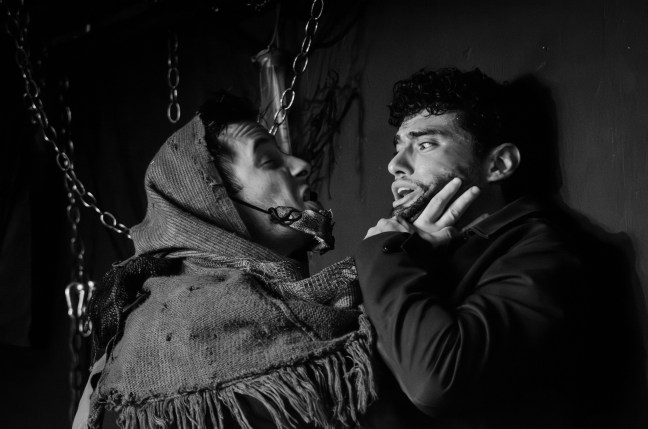
There have been many adaptations of Frankenstein over the last three centuries. Tina Taylor’s, directed at La Val’s by Lauri Smith, marks the most recent. And it’s a fascinating version. Victor Frankenstein (excellent Tyler Aguallo), creator of the monster, is, as ever, central to the script. Yet he is watched, and reimagined, by the women who surround him, and it’s through their eyes that we’re compelled to judge his battle to master death. There is Frankenstein’s mother (Jennifer Green) who can’t bear to part from her son and adopted daughter; Elizabeth (Sarah Jiang) whose marriage to Victor fulfills the dying wish of his mother (“Why would she do this?” I kept asking myself, as Victor’s cruelty and isolation increases and yet eventually he takes her as his long-suffering bride); Margaret Saville; and the chorus of woman who lift us from the ice flows at the beginning of the play and return us to the ice at the end. Women are not just the victims in this play – they’re the interpreters, the often-ironic commentators, the keepers of the faith. And as we watch the chorus of women keening, sighing, the music of their voices mixing with the exquisite sound of birds, we can see, and feel, and wonder, that life is ever-renewed, and yet no single life can ever overcome death.
The monster in this play (Sam Heft-Luthy) is wonderfully omnipresent. He’s not difficult to look at like the elephant man whom some have conjured the monster as – this creature is handsome, appealing, yet his return from the dead brings confusion, isolation, and cruel sacrifice.
One of the things I loved about Lunatico’s production is the spare utility of both costumes and set. Costume designer Elana Swartz creates beautiful wraith-like sheaths that bring the spookiness of Halloween to the story of an ancient, thwarted ambition. And the set, by Umut Yalcinkaya, evokes the very best scenic designs of bare-bones Shakespeare. A set of boxes is alternately deathbed, operating table, a boat out at sea, a seat for women to muse and chatter on. This set is brilliantly constructed, suggesting that ambition, fear, flights of imagination and descents into horror, are ours to envision with the hardware born of our own experiences. Only the simplest and most ingenious of sets can do this. There’s a clutter of objects hanging on a wall – a red-hued bag, a splattered apron. The bag becomes a carry-all for a severed head, part of Victor’s increasingly mad, isolated experimentation; the apron is used for the diabolical reconstruction, and we shiver in some measure of hilarity as he sits down to dinner with his revolted family in his blood-stained apron: “Come on, I’m hungry, let’s eat!” The haunting, hollow sounds of a grandfather clock are made by a small stick striking a box. It’s all incredibly simple in the most inspirational way.
I’d urge you to go see Frankenstein at La Val’s this Halloween. Entry is by donation. You can grab a delicious slice of pizza and a glass of wine or beer at La Val’s, descend into the theater (a bit like a descent into the horrors of Dante’s hell!); and watch what happens inside yourself when Victor tells you, “Through exquisite science and artifice I will create life. I will define life.” And yet he’ll also tell you, “For this I have deprived myself of my health, my life… for this.”
Frankenstein is playing at La Val’s downstairs, Fri and Sat 7.30 pm, Sun 3 pm, till November 2.
Philippa Kelly
Author, Dramaturg, Educator
Reviewer, Theatrius